
 It’s that time again – time for another “special election.” This time, the City of Spokane is looking to renew a levy (i. e., Tax) for emergency medical services (EMS) at an April 26 special election. But why is the city spending taxpayer money to hold a special election for this single measure instead of just adding it to the November general election ballot? Well, it’s for the same reason that every special election is held – it’s because levies, bonds and other tax measures have a better chance to pass at special elections than at general elections.
Voter turnout is far lower at special elections than at general elections. Therefore, if the particular government agency or program that is seeking the funds does a good job of encouraging voter turnout among their employees, employee’s spouses, fellow union members, associated contractors, businesses or special interest groups that will benefit, they will make up a larger percentage of the total votes cast at a special election than at a general election. This is why agencies learned long ago to have their funding measures placed on special election ballots. Continue reading “Special Elections–Where’s The Emergency?”
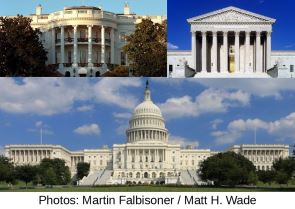 I expect we’ve all heard the phrase, “three coequal branches” used to describe the composition of our federal system of government. In fact, we’ve probably heard it so many times that we don’t even pay attention, we just accept it as fact and move on. But, is it true? Are the three branches of our federal government really “coequal?”
 When we give our endorsement to someone or something, we intrinsically connect ourselves to the object of that endorsement and to the values which it embodies, thus lifting – or lowering – ourselves to the level of the entity we have endorsed.
 My friend, Darrell Castle, producer of the weekly
  The Conservative Right seems to operate from a general assumption that things keep getting worse because liberals are in power and democrats win all the elections. However, I got curious and did a little research on the topic. I discovered that over the past 20 years, republicans have held 57% of the control of our federal government – 68% if you add in the Supreme Court – that’s a 68/32 split in favor of the republicans. Among the union states, the elephant party holds complete control (legislature and governor) of nearly half the states (23) – more than three times as many as the dreaded donkeys (7). It turns out that America is overwhelmingly republican-controlled.
 Certainly not all Muslims are terrorists who are going around blowing people up. In fact, many can be said to be living at peace with their non-Muslim neighbors. Some people contend that the problem is with just a few “extremists” who engage in acts of terror. Clearly, that was the view that George W. Bush was promoting when he called Islam “a religion of peace.”


 Perspective